
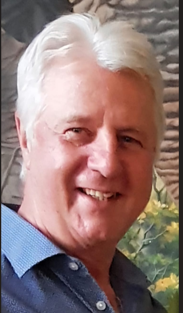
Dr Oberem is an entomologist and veterinarian, founder and former CEO of Afrivet, owner of Dabchick Wildlife Reserve in the Waterberg, a former member of the South African Veterinary Council, past president of Wildlife Ranching South Africa and of AVCASA/SAAHA, and executive editor of Rewilding SA.
Dr Peter Oberem BSc BVSc (Hons)
Rewilding: restoring balance, not just wilderness
True conservation is a science that seeks to understand the full picture, from the geology, soils and plant life to the amazingly integrated and complex “web of life”. As such, it is not focused on individual plants or animals, but on what is required for the populations of all species to flourish and be sustainable where they occur.
Rewilding is a relatively recent concept and a means of both land restoration and conservation.
Rewilding is often misunderstood as simply leaving nature alone. In the South African context, true rewilding is active, science-based restoration: giving ecosystems the tools to manage themselves again. In fact, the process in South Africa began before the term “rewilding” was coined in 1990 by Dave Foreman and defined scientifically in 1998 by Soulé and Noss, who spoke about “cores, corridors and carnivores”. The concept was later further popularised by Monbiot (2013) and the iconic centenarian David Attenborough.
The core principle of rewilding is simple: restore function by bringing back missing ecological roles, namely:
- apex predators to control herbivore numbers
- large herbivores to open up bush, and
- natural fire and water regimes that our fences and farms have interrupted.
It is not about recreating a 1652 landscape, but about rebuilding resilient, self-sustaining systems.
Over the past half century:
- the human population has increased from 3.7 billion to 8.3 billion, and is projected to peak at 10.3 billion later this century;
- cattle numbers (as a reflection of non-intensively farmed domestic livestock) have also grown, so that humans and livestock now account for 98% of global land-mammal biomass;
- agricultural land as a percentage of the earth’s total land mass has plateaued at 37% (representing 50% of all habitable land, up from 8% in 1800); while
- urban development and infrastructure have risen from 0.35% to 1% of habitable land.
The direct consequence is that the index of wild herbivore mammals, set at 100 fifty years ago, now stands at 30.6: we have lost more than two-thirds of the wildlife on earth in the past 50 years, and 80% since 1980. Sadly, Africa as a whole shows similar trends, with even larger percentage declines in its wildlife (78% over the past 50 years). Some parks in West Africa, the region worst affected by the loss of wild mammals, have lost up to 85% of their wildlife.
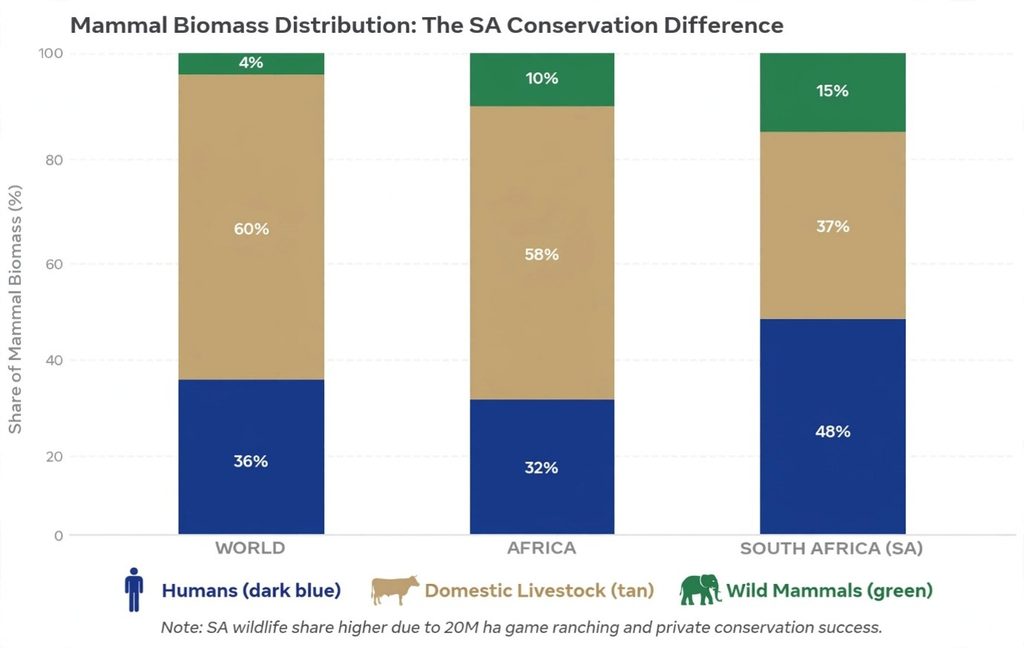
South Africa has some of the world’s best rewilding, and consequently conservation, successes.
In the Western Cape, the removal of invasive alien trees from the fynbos and the reintroduction of bontebok, eland and Cape mountain zebra (large herbivores) have shown how quickly biodiversity returns when grazing and browsing pressure is balanced. The good work done, resulting in a marked improvement in bontebok numbers, was recognised at CITES CoP20 in Samarkand, where the bontebok was removed from Appendix II.
A further illustration of the broader environmental impact of rewilding degraded agricultural land comes from the lowland renosterveld and fynbos, 90% of which has been lost, principally to agriculture. CapeNature has acknowledged the role of private landowners in the Overberg in helping to count and save the critically endangered geometric tortoise by restoring natural habitat on land that was degraded a decade ago.
At a larger scale, projects like the Karoo’s transition from marginal sheep farms to wildlife conservancies, and the Eastern Cape’s Addo-to-Great Fish corridor, prove the sustainability impact. Land that supported one economic activity now supports ecotourism, meat production, hunting and carbon storage on the same hectare. Research from SANBI, SA Hunters and the Endangered Wildlife Trust shows that well-managed wildlife ranches conserve up to three times more indigenous vegetation than conventional livestock farms.
On a national scale, 20 million hectares (more than three times the area of all the national and provincial parks together) of South Africa’s formerly mostly overgrazed and damaged marginal agricultural land are being rewilded through the unique concept of game ranching. In this process, the country’s wildlife numbers have risen from about 500 000 in the 1960s to almost 20 million at present.
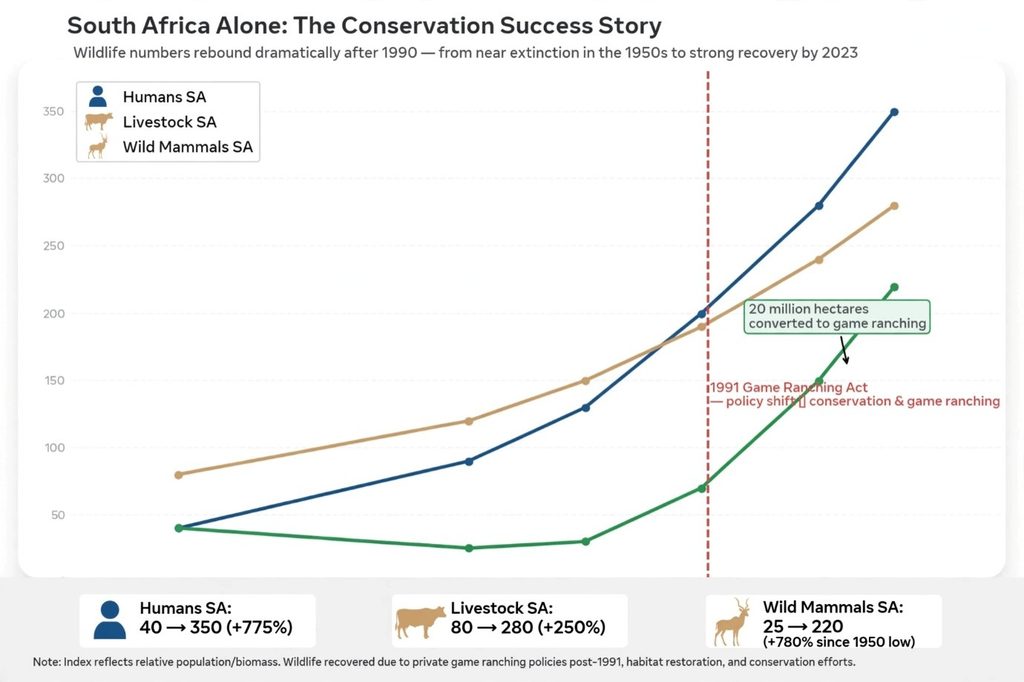
The South African rewilding, and hence conservation, success story: despite the growth in human and domestic stock biomass, as in other parts of the world, and despite the need for increased crop production to feed both, wildlife numbers and biomass have increased significantly over the past three decades. This is largely the result of the private rewilding of marginal agricultural land, driven by sustainable use and underpinned, in most cases, by hunting.
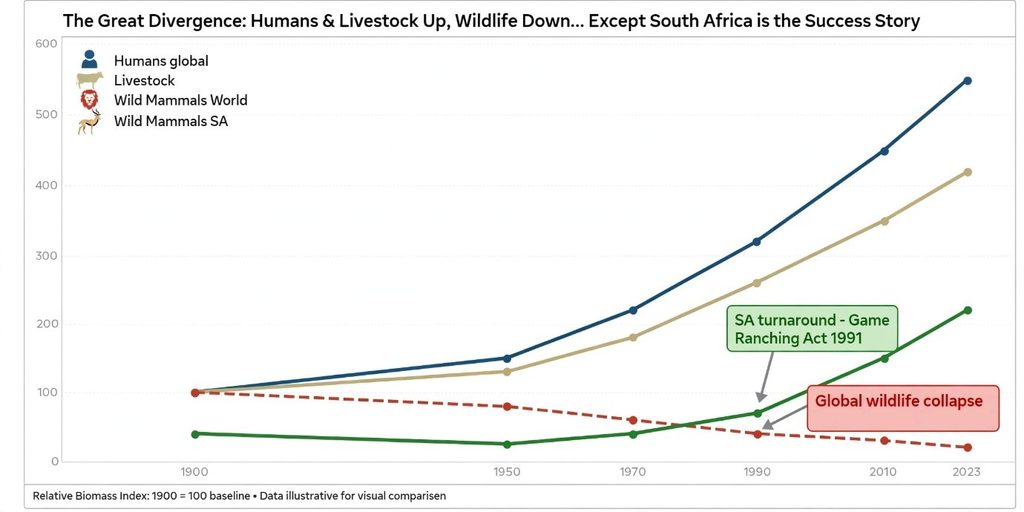
In summary, for us as conservationists, rewilding matters for a practical reason: sustainability. A rewilded system, with its complex and integrated processes, needs fewer inputs: less supplementary feed, less erosion control and less predator control. Healthy predator–prey dynamics produce healthier game populations and better trophy quality. At the same time, rewilding helps combat the threats of global warming. Sustainable-use revenue, with hunting as its backbone, has funded the return of 20 million hectares of former agricultural land to a state better suited to it, from an income, employment and conservation point of view.
Rewilding is not hands-off. It is hands-on at first, so that nature can take over later. That is a principle everyone should understand.