
Gordon Loxton, Senior Project Engineer | Lycopodium Marine and Modular
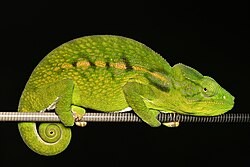
The Belalanda chameleon
Furcifer belalandaensis
This short article briefly covers a fascinating real-world project I was personally involved in. It shows how biodiversity conservation can directly influence major infrastructure projects, and how environmental impact assessments can materially affect engineering decisions and project economics, especially in ecologically sensitive regions such as Madagascar.
More importantly, it demonstrates how responsible development can help ensure that economic progress and biodiversity conservation coexist in some of the world’s most ecologically sensitive regions.
The Belalanda chameleon is considered one of the rarest reptiles in the world and has an extremely restricted distribution around Belalanda in south-western Madagascar. Its known habitat was historically limited to only a few square kilometres, which means any large-scale development in the area can have a disproportionate impact on the species.
The engineering challenge I faced was particularly significant because:
- the Fiherenana River is subject to major seasonal flooding during the rainy season, requiring a long-span bridge with careful hydraulic and scour design;
- south-western Madagascar is exposed to cyclonic weather systems originating in the Mozambique Channel, increasing the need for resilient infrastructure capable of withstanding extreme flood events; and
- environmental impact assessments identified the presence of the critically endangered Belalanda chameleon, forcing a reassessment of the bridge alignment to minimise habitat disturbance.
What makes the recent discovery particularly interesting is that researchers found individuals of the species approximately 5 km outside its previously known range, suggesting its distribution may be broader than originally understood. However, conservation authorities would still be expected to apply the precautionary principle, because the species remains classified as Critically Endangered.
I was effectively working at the intersection of infrastructure development and conservation biology. Projects such as bridges, roads, ports and mines in biodiversity hotspots increasingly require engineers to balance operational requirements with the protection of endemic species. In my case, a small tree-dwelling reptile influenced the design of a major 600 m river crossing supporting a large mining development.
Summary: critically endangered Belalanda chameleon found in a new location
Researchers from the University of Mahajanga made an encouraging discovery in April 2025 when they found three individuals of the critically endangered Belalanda chameleon (Furcifer belalandaensis) in south-western Madagascar. The species had previously been known only from a tiny 4 km² area near the village of Belalanda, making this the first confirmed sighting outside its known range. The newly discovered chameleons were found about 5 km away, near the Fiherenana River within the protected area.
Why the discovery matters
- The species is one of the rarest reptiles on Earth and is classified as Critically Endangered.
- Finding a second population suggests the chameleon may occupy a slightly larger area than previously believed.
- The discovery offers new hope for conservation and could improve the species’ chances of survival.
Key findings
- Researchers found two males and one female during surveys aimed at improving knowledge of the species’ distribution.
- Interestingly, the chameleons were found in degraded forest habitat, not in the intact forest nearby.
- This may indicate that the species is more adaptable than previously thought, although scientists caution that more research is needed.